
.jpg)



“What’s the ROI”... I get it… It’s a smart question! And in my role as a creative director (Gee Arias here!), I hear it all the time. I’ve heard it from CEOs of oil and gas companies, law firm partners, and nonprofits. But in the world of digital paid media, it can be misleading. Like in budgeting, investing, or anything else related to money, looking at standalone numbers makes you miss the bigger win.
In digital paid media, asking that question too soon or looking at it in isolation can push you to make short-term decisions that stunt long-term growth.
The truth? The most successful organizations don’t pit brand and performance against each other. They blend them. And when you get that balance right, you not only see donations today, you also create momentum that compounds for years.
Why “What’s the ROI?” Can Be the Wrong First Question
ROI matters. We all agree. But if you judge your paid media strategy on day-one results, you’re missing the bigger picture. It’s like trying to evaluate a major donor relationship after one coffee meeting. You know it takes multiple conversations to build trust. The same principle applies online.
Most people don’t take action after just one or two touchpoints. And I’d be willing to bet, neither do you. Research from Instantly.ai shows that the old “7 touch” rule is outdated. Prospects often need 5 to 12 meaningful interactions before they’re ready to commit. Cold audiences may need two to ten times more!
BCG’s research this summer on “influence maps” showcases it’s not just the number of touchpoints that matter, it’s also their impact. Influence depends on how memorable and meaningful each touchpoint is. At Masterworks, we call these “disruptive” touchpoints.
I just rambled on touchpoints but the bottom line? Those early dollars you put into ads might be planting seeds—not harvesting the fruit.
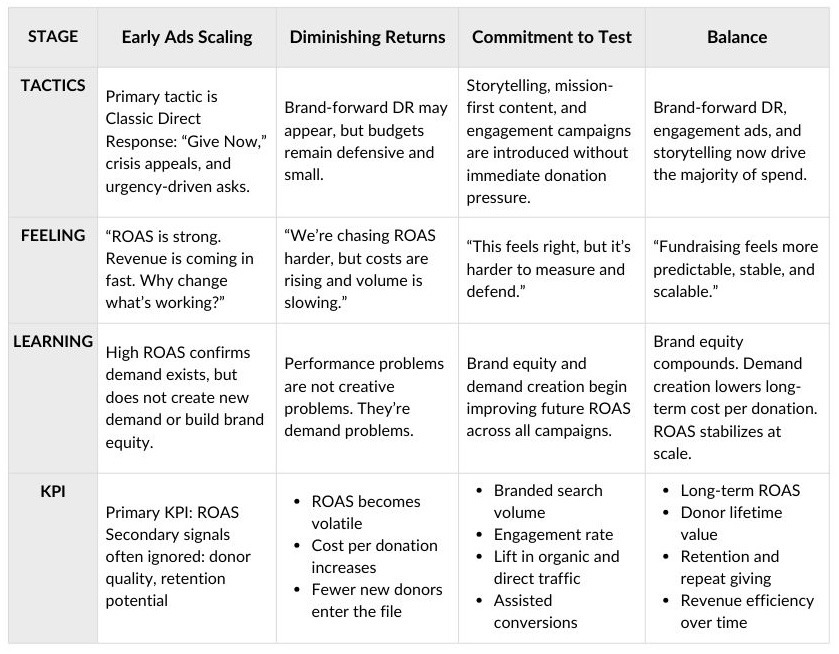
To understand why a pure ROI focus fails at scale, we look to the "Lifecycle of Paid Tactics" This framework was popularized by Preston Rutherford, the co-founder of Chubbies (a massive Direct-to-Consumer success story) and Marathon Data.
Rutherford’s model, developed while scaling his brand to a nine-figure exit, illustrates a journey that every growing organization faces:
- Stage 1: Early Scaling (The Honeymoon): You run classic "Direct Response" ads. They are conversion-optimized and measurable. ROAS (Return on Ad Spend) is high, and everyone is happy.
- Stage 2: Diminishing Returns (The Wall): Suddenly, efficiency drops. You have tapped out the "low-hanging fruit" (the people already ready to give). Costs rise, and volume falls.
- Stage 3 & 4: Commitment to Test & Balance: To break through the wall, you must introduce "Brand-Forward" creative—content that builds emotion and trust rather than just asking for money. This restores growth and lowers your costs in the long run.
The Lifecycle of Growth: A Framework for Balance
Paid fundraising doesn’t break when ROAS drops. It breaks when demand and brand equity aren’t built alongside it.
The Data Behind the Framework
While Rutherford’s model is born from real-world execution, it is validated by the gold standard of marketing effectiveness research. If you are a CFO worrying that "Brand-Forward" sounds like fluff, consider the data:
1. The "60/40 Rule" (Binet & Field) Rutherford’s "Stage 4: Balance" aligns perfectly with the research of Les Binet and Peter Field. After analyzing thousands of effectiveness case studies, they established the "60/40 Rule": maximum growth is achieved when roughly 60% of the budget goes to Brand Building (long-term demand creation) and 40% to Sales Activation (short-term harvesting). (Binet and Field)
2. The Adidas Cautionary Tale In 2019, Adidas publicly admitted they had fallen into the trap of "Stage 2." They had over-invested in direct response ads (performance marketing) because the ROI was easy to measure. However, their econometrics eventually revealed that this short-term focus was actually stifling growth. They had to pivot back to a balanced strategy—investing in brand to ensure they had a future pool of customers to convert. (“Adidas: We over-invested in digital advertising”)
3. "Mental Availability" (Ehrenberg-Bass) Rutherford’s call for "Brand-Forward" ads is an application of Mental Availability, a concept from the Ehrenberg-Bass Institute. The science shows that you cannot grow solely by targeting people ready to donate today. You must use emotional, memorable content to reach people before they are in-market, so your organization is the one they think of when they are ready to give. (Sharp)
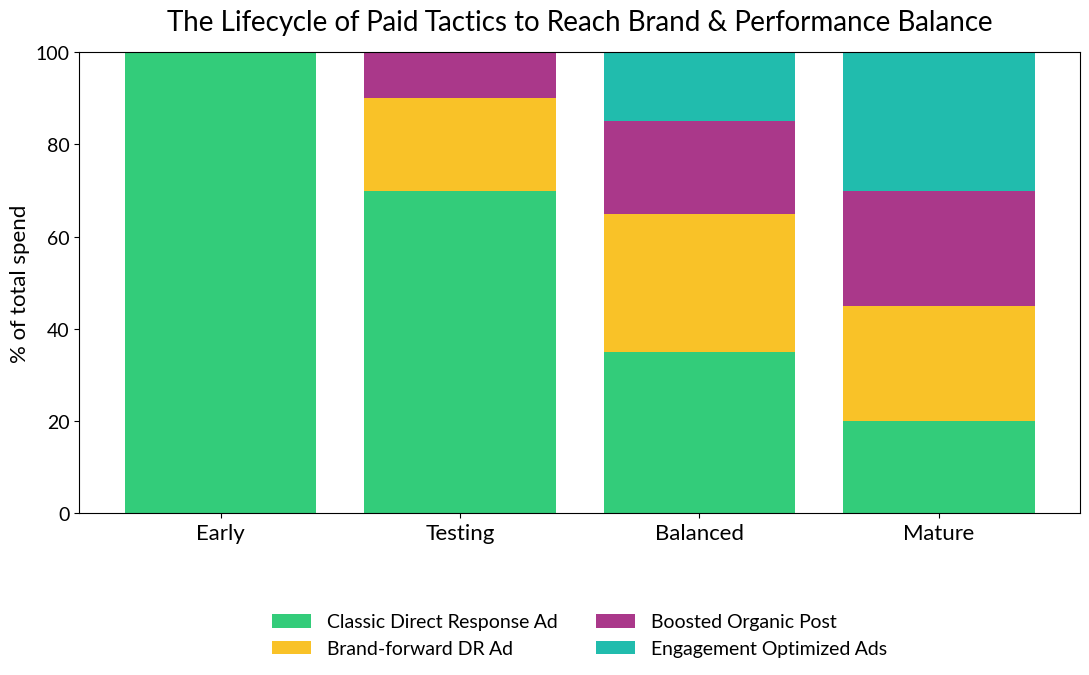
What CEOs & CFOs Should Really Look For
Instead of asking “What’s the ROI?” on day one, consider these more strategic questions:
- Are we increasing branded search volume or organic engagement over time? These are early indicators of brand strength.
- Are our new donors returning, upgrading, or sticking around? This is a downstream effect of building trust.
- Is our cost per acquisition improving in the long run? Healthy brand equity makes every future dollar more efficient.
Digital-first organizations with a strong brand presence often achieve bigger average gifts, better conversion rates, and more repeat donors. And the most successful leaders I’ve worked with evaluate their marketing like any other strategic investment: by asking if it’s building value that compounds over time and if it's seeking balance.
Think Like an Investor
If paid media were a portfolio:
- Direct Response = Cash Flow (keeps the lights on)
- Brand = Long-Term Growth (compounds over time)
- Engagement = Future Opportunities (warms up your next buyers/donors)
Ignore one and you risk over-leveraging the others.
When all three work together, you'll see an increase in donor volume, lifetime value, and mission impact.
The Bottom Line for Your Bottom Line
You don’t need to be a digital expert to understand this: If your marketing strategy only invests in what’s immediately measurable, you’ll only capture the donors who were already ready to give.
That’s not sustainable growth. And honestly, I get wary when someone starts the conversation with ROI. ROI is easy, believe it or not. But just like in business, where EBITDA is the true test of health and growth, in marketing there’s a deeper game. Ten years ago, I would’ve told you to chase ROI too. But after years of working alongside sharp marketing and financial leaders, I’ve learned there are levels to understanding growth.
Smart nonprofits are now blending brand-performance hybrid strategies into one approach. A blend of both immediate giving and steady long-term growth. The fastest-growing nonprofits are seeing compounding returns, higher donor engagement, and more diversified revenue streams.
The cost of ignoring brand investment? Missed opportunities you’ll never see on a dashboard.
If you want to see what this hybrid strategy could look like for your organization, let’s talk!