

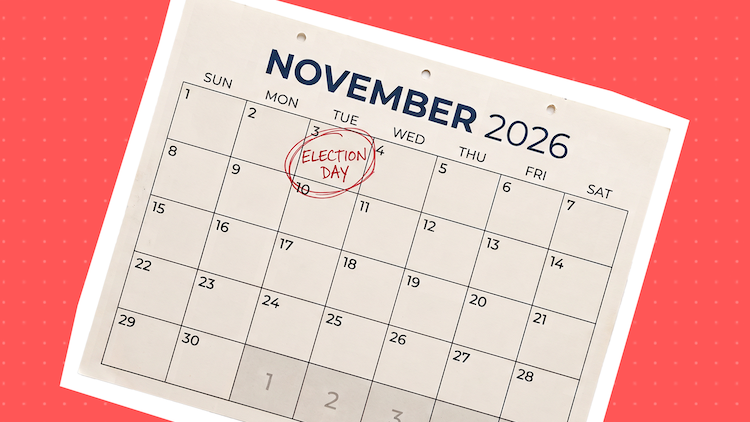
Every other year, like clockwork, it happens. Someone emails. Someone Slacks. Someone asks the question:
"Should we change our fundraising strategy because of the election?"
And the question is a reasonable one.
Election years dominate the news cycle. Political advertising floods every screen. Donors are distracted. Campaigns raise billions of dollars. It feels like charitable giving should suffer.
So every few years, we go back to the data.
We refresh our analysis with the latest information; we compare presidential election years, midterm election years, and non-election years across our non-political clients.
The results are usually surprisingly… boring. Which, in this case, is good news.
Measuring Elections Isn't Simple
Before diving into the data, it's important to note the challenges with this type of research because elections don’t happen in isolation.
Fundraising already shows seasonal improvements in the period leading up to and after the elections. Add to that the fact that Thanksgiving moves around and GivingTuesday moves with it. Then throw in that organizations spend different amounts on acquisition each year, which impacts revenue performance. Not to mention the macro trend of donor participation being in decline over the past decade.
Plus there are the unexpected events.
COVID.
Wars.
Natural disasters like hurricanes and wildfires.
Economic uncertainty and inflation.
Trying to isolate one week's election from everything else happening in the world is almost impossible.
So we attempted to simplify the question.
We looked only at existing active donors and measured the average number of gifts by week throughout the second half of the year. By excluding new and reactivated donors, we removed much of the variation caused by acquisition budgets and focused on donor behavior itself.
That gives us a much cleaner view of whether elections actually interrupt giving.
What We Found
When it comes to midterm elections, almost nothing changes for our clients whose mission is not focused on American politics in some way.
Giving patterns during midterm years are remarkably similar to non-election years. The steady climb toward year-end looks almost identical. With similar peaks and valleys.
If your organization experiences a difficult fall during a midterm election year, the election itself is probably not the first place to look.
Presidential elections are a bit more nuanced. Across three presidential elections, we saw three different stories.
- 2016: Almost no measurable disruption.
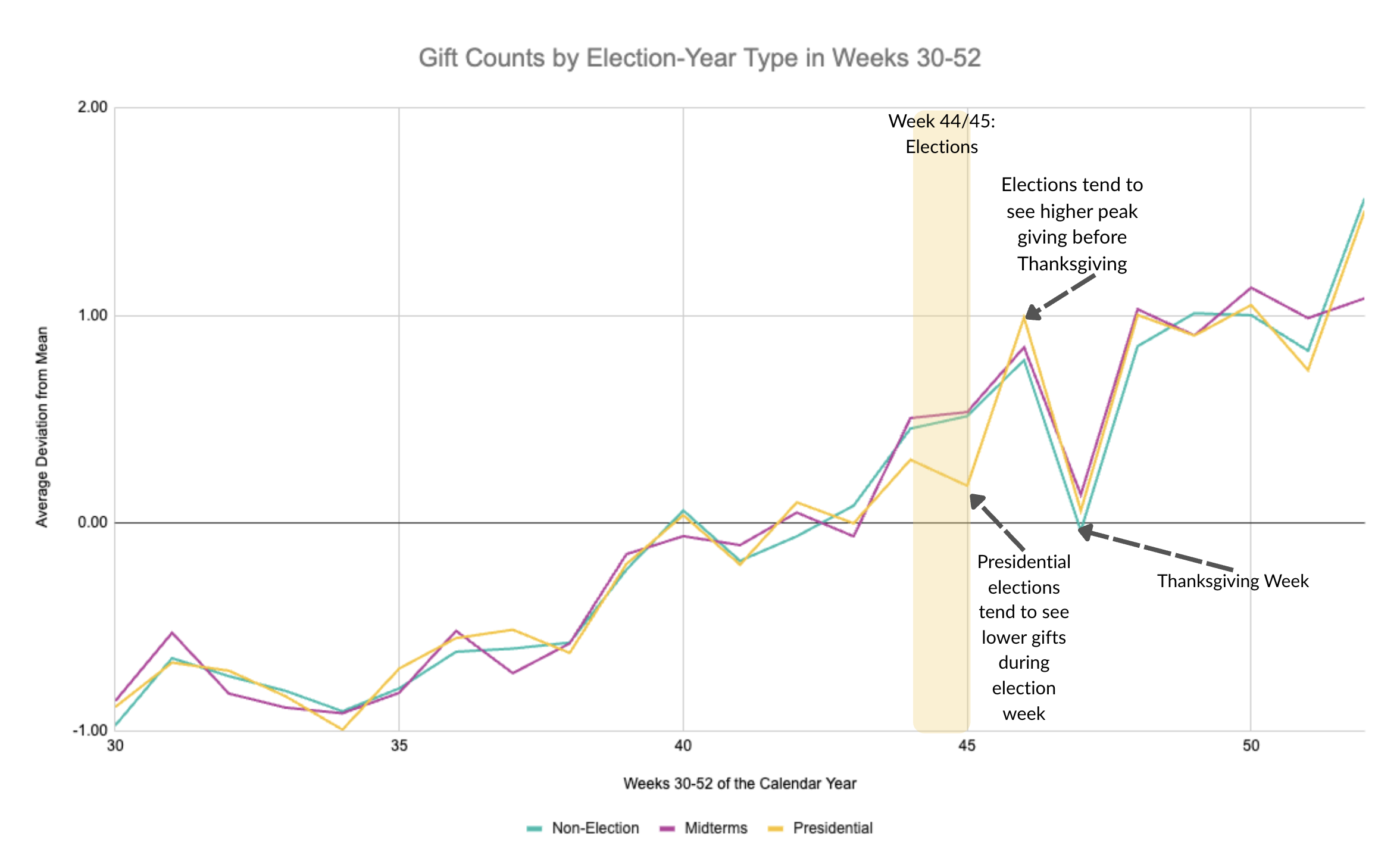
- 2020: Giving dipped around election week, but the same pattern appeared in 2021, suggesting COVID and holiday timing may have played a larger role than politics.
- 2024: A clearer decline during election week without the typical rebound we often expect afterward.
Even here, however, perspective matters. The disruption is measured in days—not months. The overall year-end giving pattern remains remarkably consistent.
A Visual
And if you are someone who loves a graph, you are in luck because so do I. This looks at the average deviation from the mean for the number of gifts sent in from the 30th week through the 52nd week of the year. It only looks at gifts from active donors and tracks giving from 2014 through 2025.
Here we see a slow climb as the average number of gifts increases closer to year-end—with a valley at Thanksgiving (probably due to mail deliverability and staff vacations) and a sharp spike at year-end.
In the graph below, teal indicates non-election years and purple shows the mid-terms. And as you can see they track closely together.
The Bigger Lesson
The real danger of the election years is that organizations start making defensive decisions.
"We should market less just in case."
"Let’s postpone our campaign until next year."
"We need to wait until after the election to send out this appeal."
Ironically, those decisions are often more damaging than the election itself.
Our data continues to suggest that maintaining consistency is usually the better strategy.
- Continue communicating.
- Continue telling impact stories.
- Continue thanking donors.
- Continue inviting supporters to participate in your mission.
Because after election week passes, people return to the rhythms they were already living.
Where I'd Look First
If year-end giving underperforms this fall, I'd be asking questions like:
- Are we giving supporters compelling reasons to stay engaged?
- Are we communicating impact consistently?
- Is our donor file growing or shrinking?
- Did we let fear drive strategy?
The answers to those questions will have a far greater influence on year-end fundraising than the election will.
The Bottom Line
Midterm elections have shown virtually no measurable impact on charitable giving to non-political causes over the past decade.
Presidential elections may create a brief slowdown during election week, but they have not fundamentally changed year-end fundraising for the organizations we studied.
So don't let the news cycle rewrite your fundraising strategy.
Stay focused on the things that have always built sustainable growth: healthy donor relationships, consistent communication, and a mission that donors are compelled to return to long after the election season has passed.