


If you had a simple, honest way to prime donors to say yes to an offer, you would surely use it, right?
There is a way, and it's most likely something you already do.
But most nonprofits aren't doing it as effectively as they could.
Story Versus Stats
Some nonprofit communicators assume facts and figures automatically make a stronger case for support and that relying on emotion weakens it.
But for everyday donors, the research says the opposite.
Share a story that shows one person in need, and donors tend to give twice as much as they do when presented with statistics about the same issue.
How Logic Puts the Brakes on Giving
Numbers are hard to conceptualize and remember. They activate the part of the brain responsible for processing and thinking.
But that thinking part of the brain is slow.
Author, researcher, and professor of charitable financial planning, Russell James III describes how numbers apply the brakes to giving by triggering the parts of the brain responsible for logic, math, and error detection.
"These regions are like an accountant who shouts, 'I object!'" says James in The Storytelling Fundraiser. "They often activate in response to number calculations."
Appeal to logic, and you risk pushing your donors into error-detection mode and stalling their decision to give.
It's the equivalent of sticking a pin in a balloon. A logical appeal immediately deflates any motivation to act.
How Emotion Drives Giving Decisions
If you like to think of yourself as a logical person, here's some news: your emotions play into every decision you make. Logic has very little say in the matter.
If you didn't have emotions, you'd become incapable of making decisions.
In From Stuck to Story, I write about Elliot, a formerly successful businessman. When a brain surgery caused him to lose his ability to feel emotion, it also damaged his ability to make prudent financial decisions. As a result, his business failed—along with the ill-conceived ventures he launched in the years that followed.
Our decision-making begins on the emotional side of the brain.
Once it settles on a decision, it sends it over to the logical side to build a case to justify it. This happens so fast we're hardly aware of it.
But it comes down to this: If you want your donor to do something, they first have to feel something.
The Desire to Be Moved, Not Manipulated
Emotionally driven stories cross the line when they're used to exploit suffering to manipulate a response.
Nobody wants to be emotionally manipulated.
But they do want to feel emotionally connected.
Using emotion ethically means telling the truth in a way that helps your audience feel the full weight of a problem as another human experiences it.
"You can either pander to someone's guilt, for which they will never forgive you," writes Bobette Buster in Do Story, "or you can dare to unlatch their heart, for which they will always be grateful."
The Bottom Line
Explaining will not move your donor to give.
Story will.
Story pulls them out of their living room and drops them in front of someone they can see, hold, and identify with. And when a story allows your donor to come face to face with someone in need, that's when they're most primed to respond—not with guilt, but with generosity.
If greater generosity is the goal, a storytelling approach is arguably your most persuasive one.
Curious for more storytelling insights?
The power of stories to move your donors is just one of the core concepts in the upcoming book From Stuck to Story: Nonprofit Storytelling WIthout the Guesswork, launching October 20, 2026.
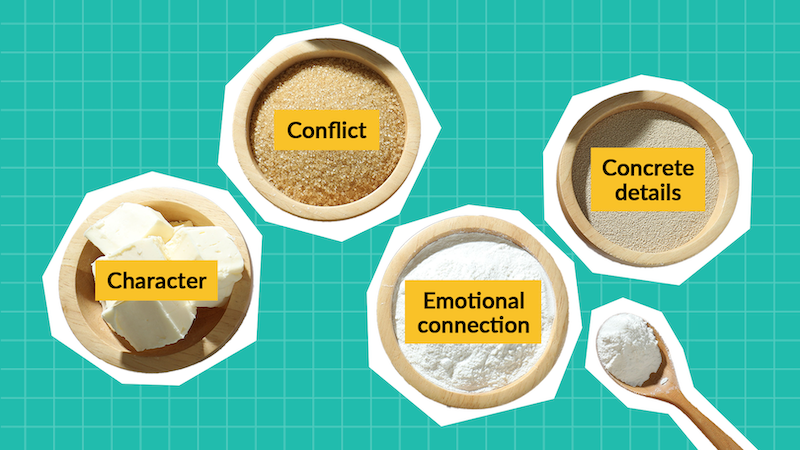
Preview the book with the Four-Ingredient Story Worksheet, a core framework for crafting stories that move donors to care—and care enough to give.
Katie Whitehorn is a Senior Copy Director and Creative Lead at Historic, part of Masterworks. We're excited to announce her new book, From Stuck to Story about how to uncover and tell stories that move people to care and act.