


The Hidden Math That Makes Fundraising Feel Like Fortune-Telling
In fundraising, we are used to looking backwards. We measure what happened, calculate the ROI, and make adjustments for next time. But what if you could see into the future, and at the moment they joined your file, you could predict how valuable a donor they would be?
That’s exactly what Long-Term Value (LTV) allows you to do when you combine it with the Growth Multiplier.
From First Gift to Five-Year Value
We’ve found that the size of a donor’s first gift is often a reliable predictor of their LTV. And by calculating the growth multiplier (which essentially measures the return from your cultivation activities), you can start predicting the LTV of a campaign from the very beginning.
Here is a real-life example:
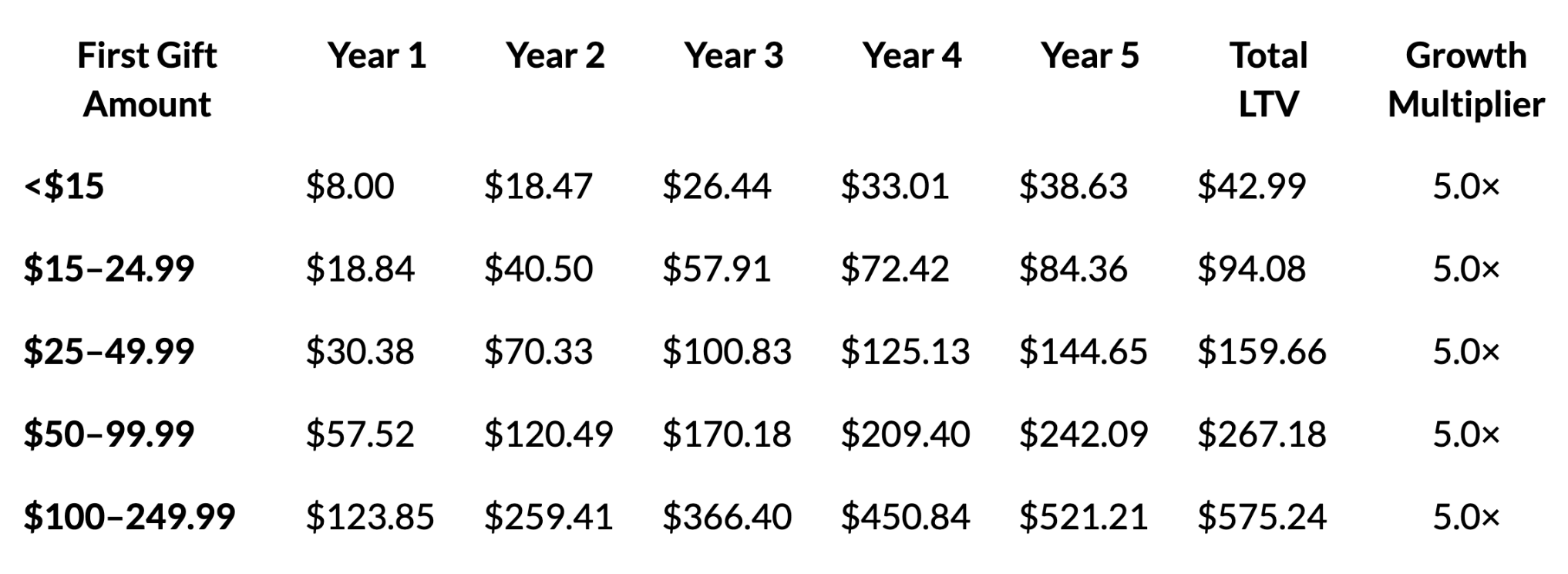
In the chart above, we grouped donors by their first gift amount, then measured their LTV over five years. From there, we divided the average LTV of each group by the average first gift, and found that, for this program, cultivation activities generally drive about five times the initial gift value over five years.
How Is This Used?
Let’s say you have two acquisition offers:
- Offer A yields more donors but a lower first gift.
- Offer B has a lower response rate but a higher first gift.
Using the growth multiplier, you can project the LTV of each offer. That lets you compare their Long-Term ROIs (LTROIs) and helps you choose the offer that will produce the highest net revenue over time, not just the highest immediate return.
When you know your growth multipliers, you can:
- Project LTV instantly at the point of acquisition.
- Compare performance across campaigns, creative, and offers in real time.
- Decide whether to scale a campaign based on future value, not just immediate returns.
It’s like having an early warning system for your acquisition program.
Want the formulas, worksheets, and real-world examples?
Download our free LTV Workbook to learn exactly how to calculate your growth multipliers and start forecasting with confidence.